
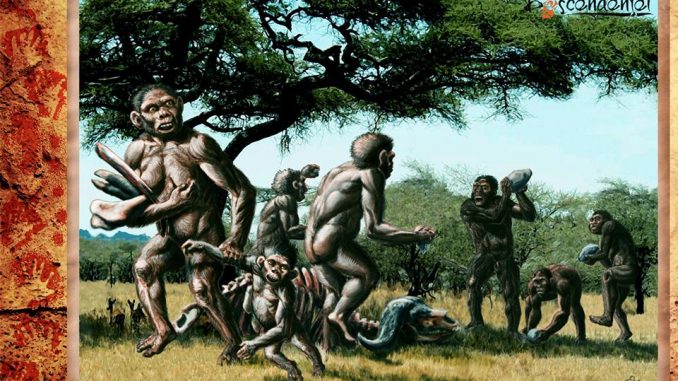
I specially chose this title. Those who are at all familiar with the biological sciences know that evidence of evolution they are everywhere, living matter has so many features common to all species, in addition, similarities at the DNA level overlap with morphological and physiological similarities between species, that's why we call them phylogenetically related. The evidence for evolution is overwhelming and readily available to neutral people, but not for those (let's not call them creationists) who reject it from the start as a bad idea. They always say that however many missing links are discovered, how many breeds of animals and varieties of plants would be artificially obtained, they are not convinced of the existence of evolution until they see it in action, that is, until I see lab-created species.
What does a species mean?? A species is a population in which there is an unlimited exchange of genes between its members, but it is reproductively isolated from other such populations. That is, until we get another population from a parent population, to be reproductively isolated from the original one, we have no evolution. The experiences that have taken place in this regard have not been satisfactory, artificial midge species later proving to be hard-to-detect wild species. However, plants are often referred to as early species.
Another problem, equally important, it is the impossibility of obtaining life in the laboratory, at least for now. If life cannot be obtained in the laboratory, its appearance being impossible out of the blue, then life did not arise from non-life, as evolutionists assume. We know the following. I will try to answer these questions through the lens of current knowledge.
Sex is the hardest to prove
What do those who deny evolution want?, to be convinced of its existence? Populations that have become reproductively isolated from the parent population. Here we are only talking about species with sexual reproduction. Otherwise, there are artificial viruses, but viruses are entities on the border between living and non-living. Also, species are also thought to exist in bacteria, although they do not reproduce sexually. However, they exchange genetic material (plasmid), and the species barrier does not really exist in this case. This is where the problem of antibiotic resistance and hospital-acquired infections starts. Bacteria exchange plasmids containing antibiotic resistance genes both within species, as well as interspecific. That is, they give their resistance genes to both relatives, as well as friends (it turns out that bacteria aren't selfish at all, they haven't passed on Dawkins' selfish gene yet, the plasmid for it has not appeared).
As for species with sexual reproduction, here things are more complicated. Sex or the lack of it (between populations) it's very hard to prove, Clinton knew this best, and showed it masterfully in the Monica Lewinsky harassment trial. Closely related species, extremely similar, of trees for example, they are reproductively isolated because they have different flowering periods. Also, in insects, closely related species are reproductively isolated because they have slightly different nuptial dances, which make them not recognize their possible partners. Reproductive isolation is sometimes about biologically unimportant details, but which have important consequences. This is actually in the spirit of Darwinism, which assumes that evolution occurs through small changes, spring.
These people who deny evolution, to the question “How then do you explain the similarities between species, if not by evolution?” he will say that they arise from the laws of the organization of living matter. According to them, man and chimpanzee do not share a common ancestor, although the similarities between these species are striking. In this case, there are even data showing that there was further hybridization between the originally separate branches that gave rise to these species (Patterson et al., 2006; doi:10.1038/nature04789).
An interesting question that could be asked of all those who deny evolution and overlook the similarities between species, that would be how they explain the linguistic similarities between languages extremely distant in terms of geographical area, spoken by people sometimes of races (POPULATION, politically and genetically correct) differently? How does he explain the similarity between Turkish and Mongolian? And yet, here we have historical documents of some migrations. But the similarity between today's Dutch and today's Hittite 3000 year old, spoken in Anatolia, Turkey today? We hope, in “The Secret of the Hittites” he even says that the cry of a thirsty Hittite, that asks for water, Of course, would be understood by a 20th century Dutchman. We have evidence that there were connections between the ancestors of the Hittites and the Dutch? There are many missing links here that we will probably never find, but no migrations, WARS, trade, and of course the sex that is indispensable in the contact between human populations, these similarities cannot be explained.
If you accept that languages may have evolved from each other, that all the multiple similarities of vocabulary and grammar are the natural consequence not of coincidence, nor of a single model of language organization (which would be, as Chomsky proposes, but at a basal level), but of the historical links between human populations, then why not admit that similarities in biology are the result of historical connections between species? Because you don't like the idea. We all reject ideas we don't like, we all believe in extraordinary things, which have no relation to reality, such as free will. But the difference is that some are more aware of it.
Let there be life in the laboratory
Another problem related to those who do not admit evolution it is the fact that the creation of life in the laboratory has not yet succeeded, that is, of the living from the non-living. The experiences we all learned from in high school only show that important organic substances in the chemistry of living things can be obtained from non-living things, or that lipids have certain properties that mimic the existence of microorganisms (the famous coacervates). But these experiences are very important for understanding life. Other working assumptions, other experimental models, which will derive from the theoretical understanding of life, will probably sooner or later lead to obtaining life in the laboratory. If nothing has been achieved so far, it doesn't mean it can't be done. Electric current was unknown for thousands of years, and today it is obtained every day in the laboratory. What will those who deny evolution say then?? If they are creationists they will probably be horrified that scientists are playing God, as they did when cloning succeeded, an incomparable success.
It's true, not much is known about evolution. If we knew everything today, if Darwin's theory had no more shortcomings, then no one would write scientific articles on the fear of evolution, no more books would be written. Books and articles are still being written about Newtonian mechanics? I personally wrote a book on human evolution, “The civilization of hunger”, not about the vertical throw. When I wrote this book, I believed, in my naivety, that it will convert many creationists into evolutionists, or at least some will no longer deny evolution. A theory that explains why the brain grew, why did the fur disappear, how human thought arose (which made language possible), specifically human sexuality, more menopauza etc., that the phenomenon that would be at their origin is one, ecologic (documented in the history of the species), which has documented effects in the direction of those changes, it might have given evolution deniers less ground to attack. In science, the simplest answer is often considered the best, especially when he answers so many questions. After the book came out, I asked such a person, which I knew was a creationist, if he now accepts evolution, when humanization can be reduced to an over-activation of a metabolic pathway. The answer was no, because he saw no artificial speciation (emergence of new species in the laboratory).
Science should be separated from religion and philosophy, and people should separate science from religious beliefs, POLICY, philosophy. When I first read socio-biology, in college, I was very scandalized by many assumptions and ideas. But if you want to reject scientific ideas, you have to do it with the means of science, if you can't, all you have to do is swallow them. I know how it is, socio-biology falls very hard on a liberal's stomach.
